
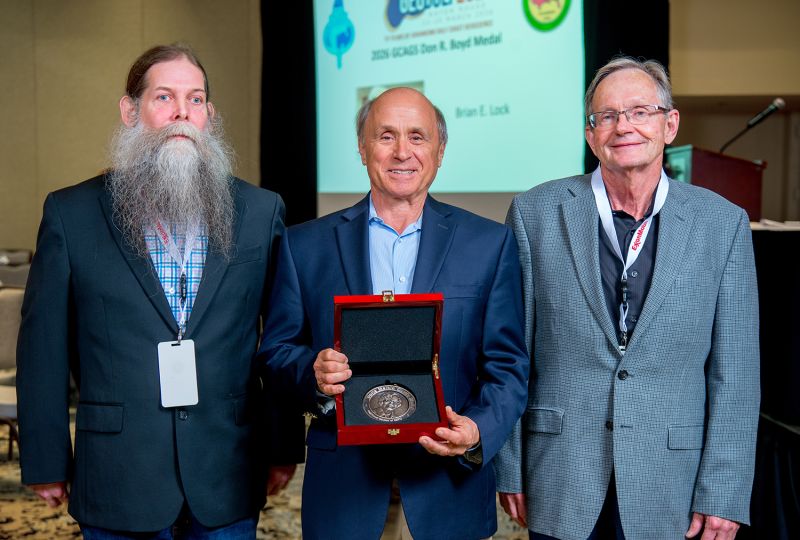
in Baton Rouge.
Photo courtesy of the Gulf Coast Association of Geological Societies
Michael Sweet, a research scientist at the University of Texas Institute for Geophysics (UTIG) and co-program director of the Gulf Basin Depositional Synthesis (GBDS) project is the recipient of the 2026 Doris Malkin Curtis Medal by the Gulf Coast Section of the Society for Sedimentary Geology.
It is the organization’s highest honor.
Sweet received this award in recognition of his numerous contributions in both research and industry towards understanding the depositional systems beneath the petroleum-rich Gulf Basin.
“Many of my colleagues whom I know and respect are previous recipients of this award, and it is a great honor to be counted in their number,” said Sweet.
Sweet joined UTIG and GBDS in 2019, serving alongside former director John Snedden. One notable achievement of Sweet’s during his time at GBDS is upgrading and greatly improving depositional models of the filling of the Gulf Basin during the Cenozoic. He used a new approach to partition Gulf reservoir volumes into paleogeographic depositional systems that are more in line with modern deepwater systems. Additionally, he oversaw the successful transition of Richard Denne as the project’s new director in 2025.
Sweet was nominated for this award by Snedden, who is also a past recipient of this medal. Snedden praised Sweet for combining his experience in the energy industry and in higher education to encourage and support the next generation of geologists interested in studying the Gulf Basin and beyond.
“In both settings, I am and continued to be impressed with his knowledge and expertise, and his ability to form a hypothesis and test it with the right geoscience tools and technology,” said Snedden. “He is and has been an excellent mentor to younger employees and students, patient and supportive.”
In addition to leading GBDS and mentoring students, Sweet still finds time to conduct his own research. He recently published a paper in AAPG Bulletin illustrating his unique approach to utilizing grain and sandstone volumetrics, demonstrating that 50% of the sand within the Wilcox group ended up in the deepwater fans. This methodology can help provide a better regional understanding of sand distribution, be that for oil and gas reservoirs, hot water for hydrothermal energy or pore volume for CO2 storage in the Gulf Basin.
The Doris Malkin Curtis Medal was established in 2007 in honor of Doris Malkin Curtis, a pioneering scientist who worked on the Gulf of Mexico for over 50 years. The medal recognizes career contributions to the understanding of the geology of this and other important basins. Sweet is the sixth geoscientist at The University of Texas at Austin to win the medal.
For more information, contact: Anton Caputo, Jackson School of Geosciences, 210-602-2085; Monica Kortsha, Jackson School of Geosciences, 512-471-2241; Aaron Nieto, University of Texas Institute for Geophysics.