
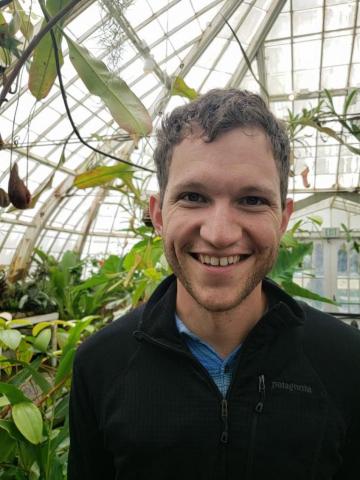
Speaker: Noah Randolph-Flagg, Assistant Professor, University of Kentucky
Title: Alien hot (and not so hot) springs: rethinking habitability beyond Earth
Host: Doug Hemingway
Abstract: Hydrothermal systems are among the most promising environments for extraterrestrial life because they can supply bioessential nutrients and chemical energy. Yet alien hydrothermal systems may have profoundly different temperatures, fluid residence times, and chemical compositions due to differences in gravity, pressure, and geology.
Using coupled models of fluid flow, heat transport, and geochemistry, we investigate how planetary environments control hydrothermal habitability on Mars and the icy moons of the outer solar system. On ocean worlds, even modest sediment accumulation can alter hydrothermal circulation, while lower gravity can produce higher temperatures and longer fluid residence times.
Despite these conditions favoring more extensive water–rock reactions, the total delivery of nutrients and metabolic energy to the ocean is likely lower than in equivalent terrestrial systems. Differences in fluid chemistry and reaction conditions can also determine whether hydrothermal systems act as sources or sinks of essential nutrients such as phosphate. On Mars, low atmospheric pressure may allow siliceous sinter to form in cooler, more dynamic hydrothermal environments than their terrestrial analogs, challenging its interpretation as an indicator of habitability. Together, these results demonstrate that familiar hydrothermal features can arise from fundamentally different physical and chemical environments, with profound implications for their capacity to support life.