
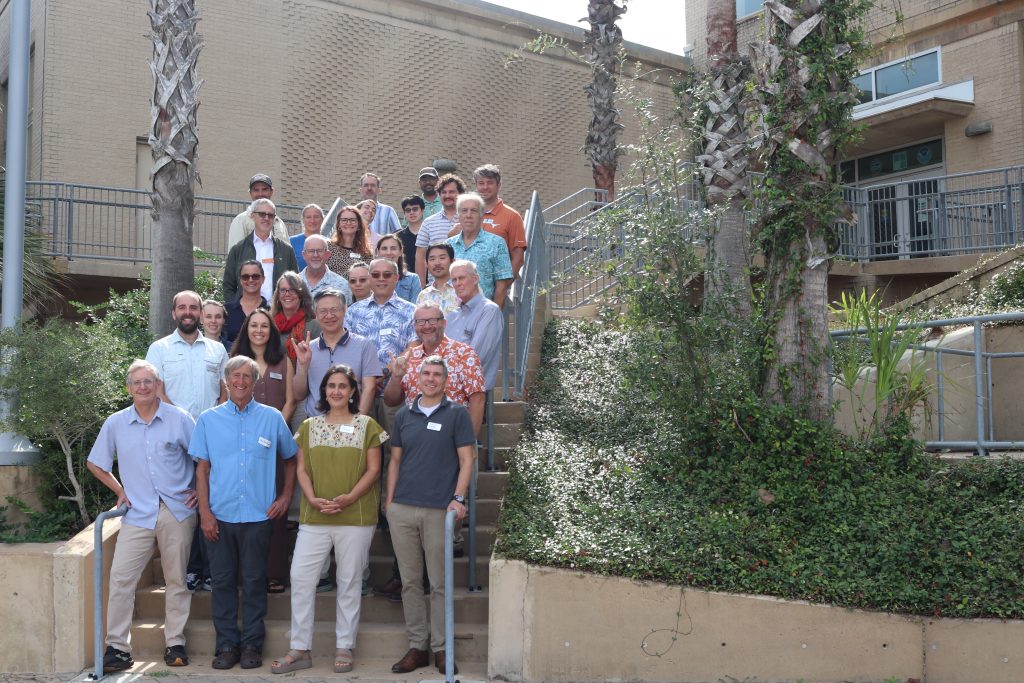
PORT ARANSAS, TX – Researchers from the University of Texas Marine Science Institute (UTMSI), The University of Texas Institute for Geophysics (UTIG), and the UT Jackson School of Geosciences (JSG) gathered in Port Aransas this week for a collaborative research workshop focused on identifying interdisciplinary opportunities that leverage the strengths of all three units. The workshop brought together faculty and researchers to share current research, develop new partnerships, and explore future funding opportunities.
Made possible through support from the Marsha and Gregg Robertson Research Endowment, the workshop provided a forum for marine scientists and geoscientists to identify shared research interests, develop interdisciplinary project concepts, and explore future funding opportunities.
The two-day workshop featured research presentations, lightning talks, and breakout discussions spanning coastal processes, geochemistry, marine ecology, hydrology, climate resilience, and planetary science. Participants worked across disciplines to identify promising research questions and areas where combined expertise could lead to innovative approaches and competitive proposals.
Several collaborative themes emerged from the discussions, including the transport of contaminants and microplastics from rivers to the Gulf, coastal groundwater dynamics and submarine groundwater discharge, the development of digital-twin watershed models to understand extreme events and ecosystem resilience, and investigations into biotic-abiotic interactions in extreme environments with applications ranging from Texas coastal systems to planetary habitability.
Workshop participants also identified opportunities for joint seed funding, shared use of research infrastructure and analytical facilities, coordinated field campaigns, and future large-scale proposal development. Discussions highlighted the value of combining UTMSI’s coastal and marine expertise with UTIG’s geophysical capabilities and JSG’s strengths in Earth and environmental sciences.
The workshop concluded with plans to advance several of the concepts, pursue funding opportunities, and explore mechanisms that will support long-term collaboration across the three organizations. By building new partnerships across disciplines, researchers are creating a foundation for addressing some of the most pressing challenges facing coastal environments while advancing fundamental scientific discovery.
Article courtesy of Sally Palmer, assistant director of communications and special projects at The University of Texas Marine Science Institute.