
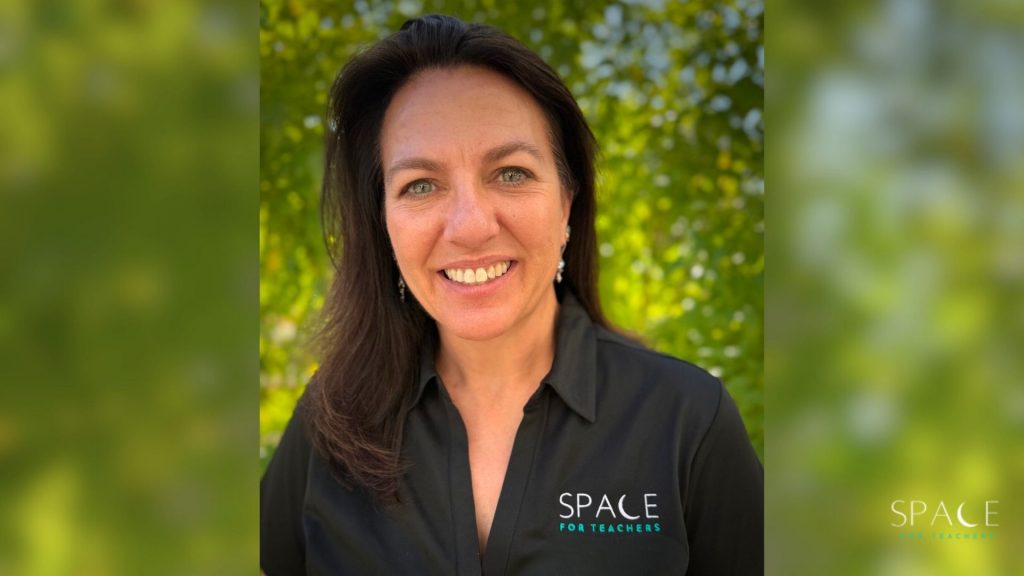
This is the first part of NASA Texas Space Grant’s Embedded Teacher Program series. This series will follow two Texas educators – Jessica Schilder and Stephanie Hanover – as they participate in the program with flight campaign sponsorship from NASA TSGC. Additional entries will be announced in future newsletters or can be found on our news page here.
When Jessica Schilder attended the Space Exploration Educator Conference (SEEC) in February 2022, she walked away with a new mission: to bring the wonder of space exploration into her classroom. Sitting in on a workshop led by the Embedded Teacher Program (ETP) team, she was struck by their enthusiasm and dedication. “I walked away from that experience thinking, I’m going to do that,” she recalls. Schilder began organizing star parties with the North Houston Astronomy Club, encouraged students to participate in national competitions, and designed lessons that sparked curiosity on a larger scale.
For Schilder, being selected for the Embedded Teacher Program is more than a professional milestone—it’s the fulfillment of a lifelong dream. “This program means I am living a dream that I have had since I was 10 years old,” she explains. As a child, she dreamed of becoming an astronaut or astrophysicist but doubted her abilities. Now, she sees her role as ensuring that no student feels the same way.
“It is my goal to make sure every student knows that it IS possible and you ARE smart enough.”
Schilder is determined to make her students integral participants in her journey. She plans to share every step of the experience, from developing experiments for the flight to launching high-altitude balloons and even working toward cubesat development. “I want them to feel like they are integral participants as much as I am,” she says. “This is just the beginning, not a one-and-done.”
Her vision extends beyond her own classroom. Schilder hopes to collaborate with junior high teachers to start similar programs, creating a ripple effect of inspiration across her district.
As she prepares for the workshop and parabolic flight, Schilder is most excited about experiencing weightlessness and seeing her students’ experiment in action. “Being able to experience a part of what it is like to be an astronaut is a dream come true for me,” she says.
Looking ahead, Schilder envisions this experience as a catalyst for bigger projects and deeper engagement. She dreams of one day launching a cubesat with her students, giving them the chance to participate in real science. “The more passion I bring into my classroom, the more my students see the possibilities they have,” she reflects. “They teach me as much as I teach them.”
Her philosophy is simple: excitement fuels learning. “The more I’m excited, the better I teach and the more my students thrive. They teach me as much as I teach them.”
Her advice to other educators is simple yet powerful: find inspiration in fellow space educators and never forget that science should be fun.