
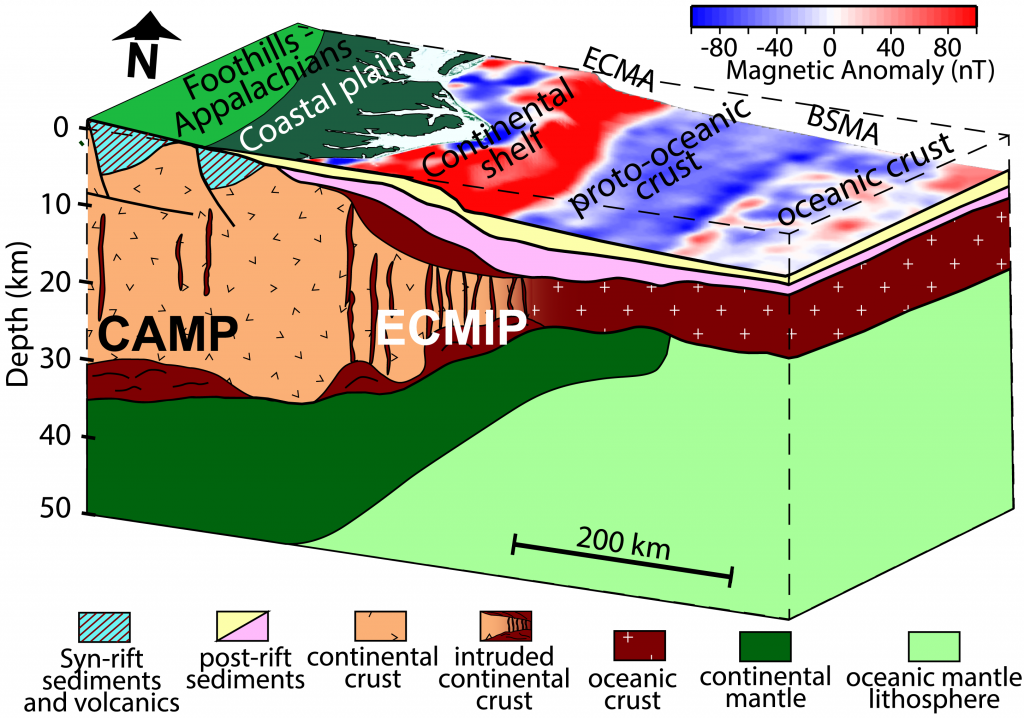
The Triassic Period ended when a gargantuan amount of molten igneous rock called the Central Atlantic Magmatic Province (CAMP) spewed out of the Earth’s mantle and into the Earth’s crust beneath what is now the eastern Appalachian foothills. Millions of years later, the supercontinent Pangea began to rip open, with the east coast of what is now North America separating from West Africa to form the Atlantic Ocean.
Geologically speaking, these two events happened close enough in time that many researchers believe that the emergence of this magmatic province is what caused Pangea to begin to break apart. But new research led by the University of Texas Institute for Geophysics (UTIG) finds that CAMP’s role in the breakup of the supercontinent was not as robust as previously thought. The scientists suggest that a different magmatic upwelling that created the tectonic feature known as the East Coast Magnetic Anomaly could be what drove Pangea’s big breakup. This event occurred millions of years after CAMP along the east coast of the U.S.
This research was published in Geology and revises the story of the way Pangea fragmented.

“Continental separation caused a second pulse of magmatism offshore the eastern United States along the East Coast Magnetic Anomaly 15 million years after CAMP,” said Harm Van Avendonk, a research professor at the Jackson School of Geosciences and UTIG and lead author of the paper. “That’s a significant delay that calls into question whether CAMP triggered the opening of the Atlantic Ocean.”
The researchers found solid evidence for this later pulse of magmatism driving the opening of the supercontinent while conducting seismic mapping on the east coast of the United States. The team sought to create a more complete picture of the Earth’s crust at the U.S. Atlantic coastal plain, specifically between the eastern Appalachian foothills and the deep seafloor of the western central Atlantic Ocean. This stretch encompasses the structures in the Earth’s crust and mantle that resulted from rifting and continental breakup that occurred around the time CAMP appeared, including the East Coast Magnetic Anomaly.
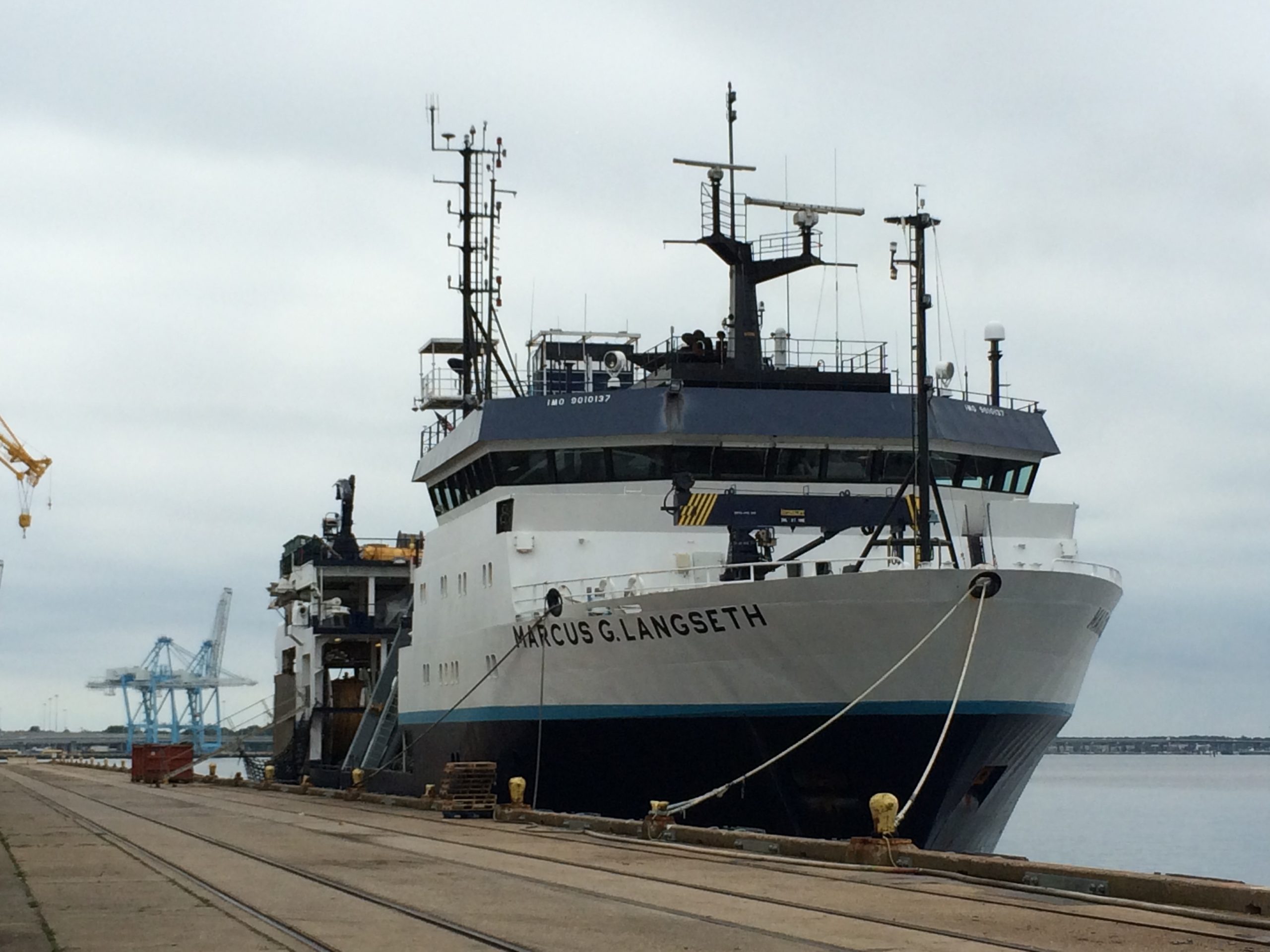
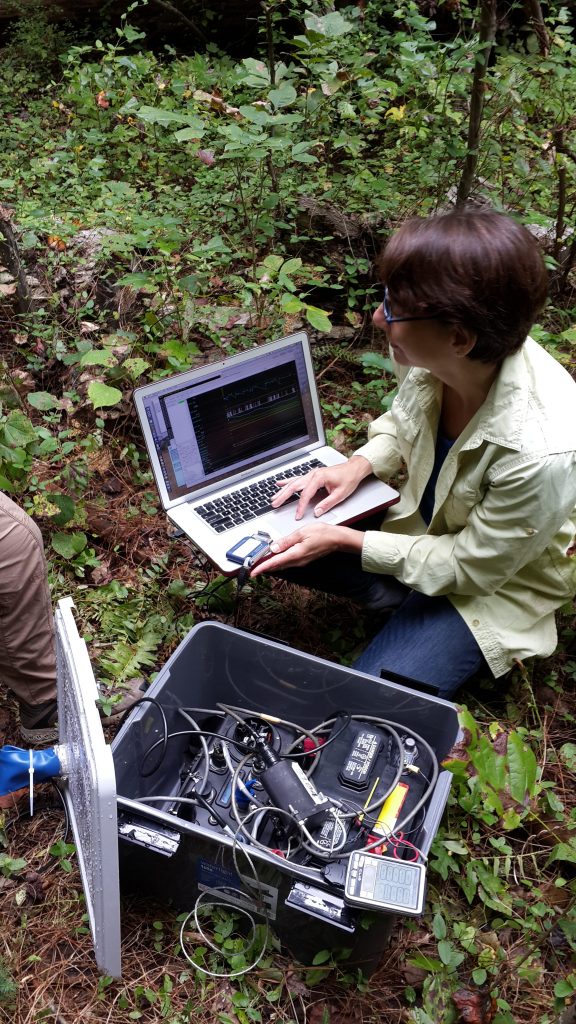
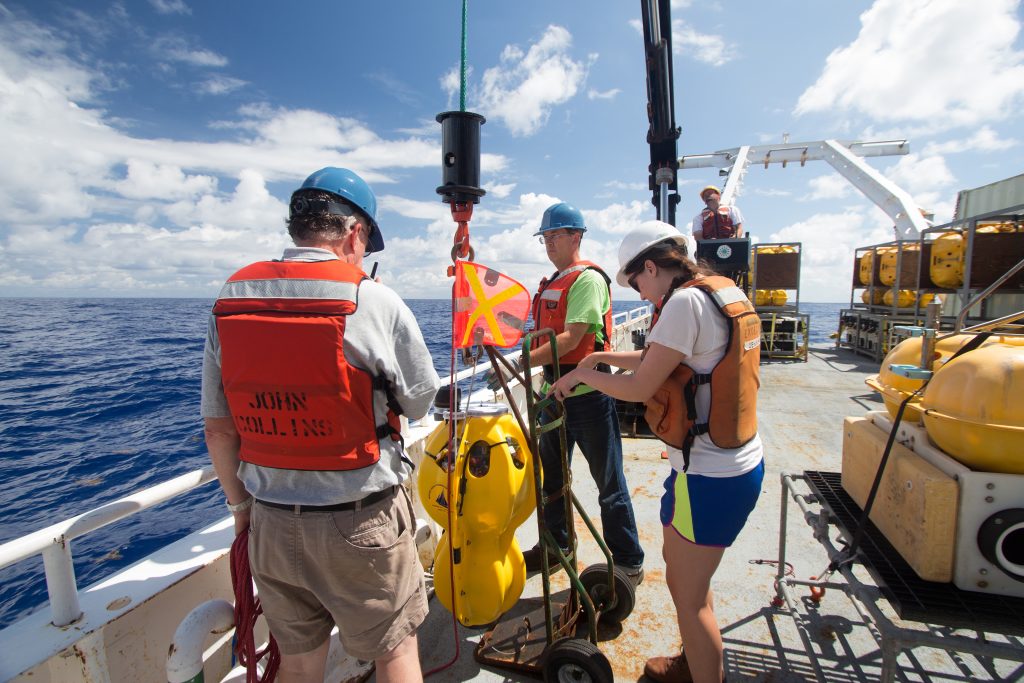
The team conducted a series of on-land and offshore surveys to measure seismic velocity, the speed in which sound travels through rock of the crust and upper mantle across these parts of the east coast.
They found that the magmatism associated with the opening of the Atlantic Ocean did not originate from CAMP; it occurred offshore, along the East Coast Magnetic Anomaly.
The survey results showed that the crust beneath the foothills was about 35 kilometers thick and narrowed closer to the anomaly, with only the lower few kilometers of crust containing seismic velocities matching speeds of magmatic rock. For CAMP to have had significant influence on crustal separation, a much thicker layer of material with seismic wave speeds matching those of magmatic rock would need to be present.
In contrast, at the anomaly there are signs of narrow rifts that were filled up by magma after they formed. This exemplifies the type of crustal structure formed by continental separation.
“The eastern North American margin has long been a poster child for magma-rich rifting associated with CAMP, but these findings demonstrate that the volume and distribution of magmatism on this margin, including from CAMP, is highly variable, and that the connection between CAMP and continental breakup is not as simple and clear as previously supposed,” said Donna Shillington, co-author of the paper and professor in the School of Earth and Sustainability at Northern Arizona University. “It is an important step forward in our understanding of the drivers of the most recent episode of supercontinent breakup.”
Now that Van Avendonk and his team have identified CAMP’s limited role in the opening of the Atlantic Ocean, they are now turning their attention to the Blake Plateau, a plain submerged 700 meters deep within the Atlantic Ocean. This crustal feature also lies along the anomaly, south of where the team surveyed and shows signs of a much larger magmatic outpouring that could provide more insight into the tectonic puzzle that is Pangea’s separation.
“Looking at these ancient volcanic features along the eastern U.S. margin can help us understand how major magmatic events influenced the reorganization of continents,” said Van Avendonk.
For more information, contact: Anton Caputo, Jackson School of Geosciences, 210-602-2085; Monica Kortsha, Jackson School of Geosciences, 512-471-2241; Aaron Nieto, University of Texas Institute for Geophysics.